Showing posts with label books. Show all posts

Sunday, February 21, 2016

My Top Ten Reads of 2015

Whew!

Call this the blog that almost didn't happen.

 I kept track of all the books I read last year like a dutiful book blogger (I read 36 by-the-by), noting which could be candidates for my Top Ten list along the way. Then in late December I actually compiled the Top Ten list, intending to write and publish this post either just before or just after the New Year.

Heh. Heh.

Best intentions, right?

Oh well. Let's get down to it, shall we? I have the same rules as I had in previous years: all styles of books are fair game because I'm not a pretentious bitch, and only one book by any given author can make the list, because I like to make equal opportunity Top Ten lists. I already reviewed some of the books that made the cut this year, and when relevant I will link to those reviews. In years past I linked to each book's kindle page but I think I will cut that part out with this end-of-year literary list. I read both electronic and dead tree books (aka paperback) and I feel like linking to ebooks only might come across as preferential. 

I don't want to tell you how or what or why to read. That's not my business, so long as you actually fucking read. This is a literary world, after all. 

And now the Top Ten list:

(10) Farewell, My Lovely by Raymond Chandler


Raymond Chandler was one of the founding fathers of noir fiction. Phillip Marlowe, the fictional PI he created is the literary godfather to all who followed him. If you've never given noir a try, give THIS one a try. If you love modern hardboiled fiction but have never explored its predecessors, fucking do so now.

(Also, if you have an hour or so to kill and are possessed of a sense of humor and a love of a well-turned line, go look at @chandlerisms on twitter. The account tweets only lines from the master's books. Lots of fun.)

(9) Mr. Penumbra's 24-Hour Bookstore by Robin Sloan


This book was so, so, so much fun. It managed to somehow be both in love with technology and Luddite-ish at the same time. I don't want to say much else, except: read this fun, fun, fun book! And check out @penumbra on twitter.

(8) The Corrections by Jonathan Franzen

I didn't want to like this book, but I did. And I wrote about it here. 


(7) Gone Girl by Gillian Flynn

My boyfriend Brandon and I both read this book early last year. It was phenomenal! Then we watched the movie. It was ok. Not phenomenal, but not horrible.


(6) The 8 by Katherine Neville

This was one of a short stack of paperbacks that Brandon pulled off one of his shelves and handed to me because he thought I might like them. And my fucking god was he right!! Holy intrigue! Reading this felt like reading one of Agatha Christie's political intrigue novels.


(5) Warning Signs by Stephen White

This was another book from Brandon's short stack. It was the last book I read in 2015 and I loved it so much that so far this year I've read three more books from the same series, and I am currently reading a fourth. Yep. Love me Stephen White.


(4) The Fault in Our Stars by John Green

Please believe me when I say that I am done fangirling all over John Green. But I couldn't honestly leave this book off my list. I didn't so much READ this book as I INHALED it, in a few short hours (spread over 2 days) after which I sobbed like a little bitch. 

Reading John Green novels turns me into an emo 17-year-old. Check out an old post I wrote about how John Green writes about young girls. 


(3) The Last Call by George Wier

George Wier is an author I discovered in 2015. I started with this book, The Last Call, which is the first in a series of noir mysteries set in my town: Austin Texas! I loved it so much that I went on to read three more books in the series, and I plan to read them all!


(2) To Kill a Mockingbird and Go Set a Watchman by Harper Lee


Okay, so maybe I'm cheating a little by bundling both of Lee's books into one slot on my Top Ten list. Maybe, but I don't think so. If you buy the argument (and I do) that Watchman was the rediscovered first draft of Mockingbird, they can really be taken as different versions of the same story. Even if you don't buy that argument, Watchman is best appreciated in connection with Mockingbird.

I blogged about the pairing last summer. Take a look here. 


(1) The Great Gatsby by F. Scott Fitzgerald


Full disclosure: my reading of The Great Gatsby in 2015 was my second read-through of this novel. Like most Americans it was required reading for me in high school. But high school me HATED this book. I found it by turns boring and pretentious. I walked away from Gatsby with the impression that in it Fitzgerald celebrated the excesses of the leisured elite. That really pissed me off.

Boy was high school me thick. I completely missed the point of Gatsby. This time around, with a number of years and a TON of life experience under my belt, I found I could not merely appreciate, but actually LOVE this book. I'm so glad I gave it a second try.

Thursday, November 26, 2015

Reading Jonathan Franzen, a Sort-Of Review of The Corrections

I'm always incredibly late to the party.

This year (2015) I finally read The Corrections by Jonathan Franzen, a book that came out in 2001 and immediately took the Literary world by storm.

I didn't wait 14 years to read the book because I hadn't heard of it. I was aware of it. Books that are as successful and highly praised as The Corrections are difficult to ignore.

In fact, I thought about The Corrections a little too much for a book I intended never to read. I picked it up countless times at book stores and libraries, fingering the pages, eyes roaming the cover, thinking "Maybe? No." Before putting it back down.

I just couldn't bring myself to read it. Why? Because of 2 things I had read about the book and its author: (1) The Corrections is a literary masterpiece, and (2) Jonathan Franzen is a pompous windbag.

I have no idea if Mr. Franzen is as much of a douchebag as twitter asserts. Just for fun, I suggest you google "why the internet hates Jonathan Franzen" and read some of the articles that come up.

What follows is a review of sorts. It's not so much a review of The Corrections itself as it is a review of my experience of reading a Jonathan Franzen novel. (Oh yes, I'm that self-involved.) In list form, because lists.

(1) The cover of The Corrections is a case study in the culture war between literary fiction and genre fiction.

You might think that the book's cover art is fairly simple and innocuous, but you would be wrong. The picture is of an American family sitting down to what is presumably a holiday meal. The family is white and probably at least middle class, as evidenced by the Sunday best that the two young boys you can see are reluctantly wearing.

(I'm comfortable assuming that this is a holiday meal because of the gorgeous turkey that is proudly presented by the matriarch of the depicted family. Turkeys are understood as the cultural centerpiece of American holiday meals, despite the fact that not every family chooses to have one.)

Book covers are designed to entice readers to buy the book. In order to do so, they attempt to create a feeling of kinship between the readers and the book, as well as the book's author. The symbolism used in the cover art, therefore, is not accidental.

JONATHAN FRANZEN is emblazoned across the top third of the cover, in larger typeface than The Corrections. The picture of the family-at-holiday-mealtime takes up less than 25% of the cover space, and is pushed down to the bottom of the cover.

Between the title of the novel and the picture is a blurb from the New York Review of Books:

"You will laugh, wince, groan, weep, leave the table and maybe the country, promise to never go home again, and be reminded of why you read serious fiction in the first place."

Where to begin?
Setting the author's name in larger typeface than the book title suggests that the author is a larger draw than the book itself, and thus more important. So, from the outset the reader is being told that Jonathan Franzen is a Super Important Dude.

Mr. Franzen's  name is so large on the cover that it dwarfs the picture beneath it. But that's not all. The position of his name in relation to the picture, as well as the size of his name in relation to the picture, are both meaningful and problematic:  unless you're white, middle class, and exclusively read literary fiction, in which case this cover just reinforces your pre-existing world views.

But I'm not talking to those people.

This cover associates Jonathan Franzen, as an author and public figure, with the middle class, middle class culture, and middle class ideals. But, since his name lords it over the rest of the cover art, it also elevates him above those very people and ideals. He is both of the privileged class and better than the privileged class, and from his vaunted position, he is qualified to judge the rest of the people in it.

The blurb from the New York Review of Books serves to assure the reader that he/she has a place at the holiday table. He/she is being told explicitly that "yes. You are one of us." The reader is acknowledged to have a background similar to those in the picture (and, presumably, to that of Jonathan Franzen himself). The holiday meal depicted on the cover is referred to as Home. This book, therefore, is being presented as a shared experience.

But it's not just The Corrections that is being shared. Also implied as shared between the readers of the novel and the book's author is the middle class American experience, and all that that includes: material comfort, stability, an above-average education that includes college, parents that probably don't love each other but probably also don't beat you, and boredom.

Oh, and Serious Fiction. Mr. Franzen writes Serious Fiction and his readers and cohorts exclusively read it.

There are others, of course, who aren't invited to Mr. Franzen's shared literary experience. Those who are too poor, maybe, or too uneducated, to read Serious Fiction. Who are they? Readers of genre fiction, of course. And I am one of those people.

Hence my long-time reluctance to pick up and actually read The Corrections.

(2) I absolutely fucking loved The Corrections

I so hate to admit this, after having so thoroughly dissected the book's disgustingly elitist cover art. But it's true. It will likely end up on my end-of-year top ten list.

(3) I will likely read Mr. Franzen's newest and even more controversial novel Purity. 

Saturday, July 25, 2015

The Dog Days of Summer

"Calpurnia listened. 'I know it's February, Miss Eula May, but I know a mad dog when I see one. Please ma'am hurry!'"

-- To Kill a Mockingbird

A lot has been said, surmised, and written about the scene in Harper Lee's classic novel in which old Tim Johnson, beloved neighborhood dog, is found to have gone "mad" (rabid) and is shot dead by Atticus Finch in front of his shocked children. Atticus, once hailed as the best shot in the entire county, is not a gun owner and has never handled a firearm in front of his family. Atticus Finch is a gentleman.

Ahem. Well. That is a discussion for another time and place. Here we will focus on the interesting and unexplained insistence in the novel that dogs do not, as a rule, "go mad" in the winter time.

Having grown up in cities with generally well-funded animal control departments, I have been fortunate enough to have never seen a rabid dog. I do know that rabies is passed from one infected dog, bat, or human to another through contact with bodily fluids, usually via bites. So when I read this scene in Mockingbird my first thought was: "What the hell does the season have to do with the presence of a rabid dog?"

My second thought was: "Oh my God! Is the notion that dogs only go mad in the heat of the summer the meaning behind the phrase dog days of summer? If so, is To Kill a Mockingbird the origin of that phrase?"

Short answers: sort of, and no. According to Wikipedia, the phrase originated way before Harper Lee was even born and had more to do with astronomy than anything else. But the sentiment behind the saying remains the same, generations later. From an 1813 poem:

Dog Days were popularly believed to be an evil time "the Sea boiled, the Wine turned sour, Dogs grew mad...

Mad dogs just need to be loved.


Saturday, December 27, 2014

My Top Ten Reads of 2014

Welcome to my Second Annual Top Ten Reading List!

This just might be the least important Top Ten Reading List you'll come across this holiday season. Unlike others, my list isn't comprised only of books that came out in 2014, nor is it a Top Ten List of books by HOT NEW AUTHORS. Theses aren't books of Earth-shattering importance, and they're not books written by self-published authors who are on the rise.

These are just books that I stumbled across this year, read, and fell in love with.

That's all that I want out of my books. I won't tell you how to read or who to read, but I want to highlight these books because I think that you may enjoy them. Okay?

First things first: I read 29 total books this year. More than some of you may have read, and definitely less than a lot of you read. I read self-published books and traditionally published books, fiction and non-fiction. When it comes to my Top Ten List I only have one rule: any given author may only have one book on the list. To do otherwise just seems to me unfair. That limited how I could shape my list, however, as I discovered and fell WAY in love with three authors this year: Donald Westlake (I read three of his books), John Green (I read three of his books as well), and Nelson DeMille (I read a whopping SEVEN of his books this year).

So you can probably understand my rule now, huh?

Here's your alert:


SPOILERS AHEAD!!

And away we go!!

Number Ten: The Ghost of Blackwood Hall by Carolyn Keene

If you've spent any time at all on this blog, then you already know of my affinity for the Nancy Drew Mystery stories. I've reviewed a few of them before. The character of Nancy Drew was an early feminist icon for young girls and her stories are chock full of adventure and spine-tingling moments. I love them. Has it been a decade (or more) since you spent an afternoon with Nancy? Pick one of her books up again. I guarantee you won't regret it.

Number Nine: Beyond Hades by Luke Romyn
Beyond Hades is an action-packed thrill ride based on one crazy notion: Greek mythology is real and someone has opened the gates to Hades, unleashing monsters of unspeakable ferocity. Pardon my pun, but what in the HADES would we do in that situation?

Call in the military, an academic, and a time-traveling Aussie to save the planet. 

Seriously. This book is just that crazy and just that fun. It also ends on kind of a cliffhanger, but don't worry: there's a part two.


Number Eight: 12 Years a Slave by Solomon Northup

In the late 1800s an African American man named Solomon Northup wrote a harrowing memoir that raised a few Victorian eyebrows before it slowly faded from the limelight until it was made into a movie of the same name earlier this year. I heard of the movie and decided I would rather read the book.

If you are an American I urge you to read this memoir. It will change the way you think of our history. Yes, we all know our nation was built on the backs of slaves. Yes, we all know that a war was fought that ultimately resulted in the freeing of those slaves and the simultaneous creation of a category of second-class citizenship, the echoes of which are still felt today. We all know this. 

But the real, lived experience of an American slave is something most of us have the good fortune to know nothing about. And shame on us for that. If we as a nation are ever to be able to move on from the continuing impact of our bloody heritage, we all must be made to face the truth of it.

Solomon Northup was a Northerner who was born free. His father, a lifelong slave to a man with--at the time--progressive views on the subject, was freed in his master's will. Solomon was taught to read and write, to farm, some basic carpentry, and also learned to play several musical instruments. When he became a man he married his sweetheart and started a family. And then he was kidnapped and sold into slavery. And because of all of the laws that governed slaves and their movements, he couldn't just go to the police and explain that he was a free man. So he spent twelve long years toiling under the yoke before he finally managed to prove his status and return to his family.

This is a gut-wrenching tale. I challenge you to make it all the way through without shedding a tear.


Number Seven: Hyperbole and a Half by Allie Brosh

Hyperbole and a Half is a book that grew out of a blog of the same name. Check it out! But even though I have a blog of my own I tend of walk around woefully unaware of what's happening on the interwebs, so I bought the book without knowing anything of its predecessor. AND I FUCKING LOVED IT. If you know the blog, you know what to expect from the book: lots of super colorful illustrations and soulful venting. Buy it. Read it. And laugh until you cry or piss your pants or both.


Number Six: The Perks of Being a Wallflower by Stephen Chbosky
I loved, loved, loved this book.
But I have an embarrassing confession to make: I watched the movie first. I know. That's completely backwards. You're always supposed to read the book first. That way, while you're watching the movie, you can fit together the pieces that don't make sense, and you'll know what was left out. You can read my review of the movie HERE.

The Perks of Being a Wallflower has everything I love about YA books. There's a protagonist who agonizes about not being "normal," fierce friendships that start in uncomfortable ways, and the roller coaster ride of adolescent self-discovery. There's so much Why am I this way? Why are we this way? How can we make the world better/happier/more peaceful/ more exciting?? But it's never too much. None of it is shoved down the reader's throat. In fact, the manner in which Mr. Chbosky wrote the novel allows for the reader to be made to feel uncomfortable in a natural, almost inevitable way. Sort of like reliving adolescence. It is a MASTERPIECE of storytelling.

Also, the story is set in State College, Pennsylvania. I once lived there. If you ever lived there, you will enjoy all the State College references. 


Number Five: The Basic Eight by Daniel Handler, aka Lemony Snicket

For the record, I didn't know Daniel Handler was Lemony Snicket when I read this book. Nothing against Lemony Snicket or his Series of Unfortunate Events, but I picked up The Basic Eight because it--and it alone--enticed me.  

There's not much I can say about this book without giving away crucial plot points. I don't mind a spoiler or two in a review but these are Fight Club level twists and I want you to have the same level of enjoyment as I did when I read it. So I'll leave you with the Amazon blurb:


Flannery Culp wants you to know the whole story of her spectacularly awful senior year. Tyrants, perverts, tragic crushes, gossip, cruel jokes, and the hallucinatory effects of absinthe -- Flannery and the seven other friends in the Basic Eight have suffered through it all. But now, on tabloid television, they're calling Flannery a murderer, which is a total lie. It's true that high school can be so stressful sometimes. And it's true that sometimes a girl just has to kill someone. But Flannery wants you to know that she's not a murderer at all -- she's a murderess.


Number Four, Truth in Advertising by John Kenney

I picked up Truth in Advertising at Half Price books. It was a pure impulse buy. I knew nothing of John Kenney and the cover art didn't tell me much about the story, but I had a feeling I would like it, and I was right. Buying Truth in Advertising was a damned good rash decision. Smart, funny, fresh, and almost unnervingly wise. I had so many "A-ha!" moments while reading. I highly suggest this read!


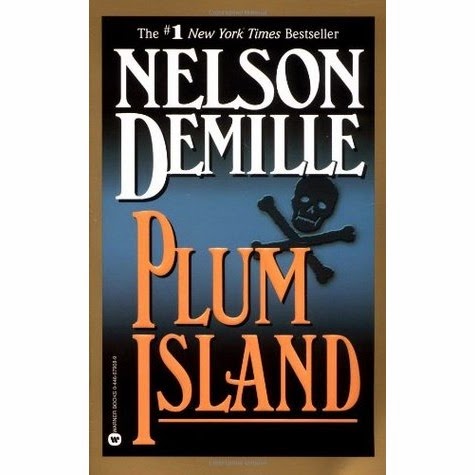
Number Three: Plum Island by Nelson DeMille

I said in the introduction that I read seven books by Mr. Nelson DeMille this year. When it came time to compile this Top Ten list I knew that one of his books had to be included, but I wasn't entirely sure which one it would be.

I did know one thing, though: whatever book I chose was going to be a John Corey book. 

John Corey is a recurring character in Mr. DeMille's books. He's also my favorite literary alpha male. I dedicated a whole blog post just to him. Check it out! 

Plum Island is the very first in the series of books that feature Mr. Corey. And it's awesome. Unlike other books on this list, Plum Island isn't deep. There's no brooding, no angst, and no characters who agonize about who they are really. You know in their souls. Don't get me wrong. I love angsty characters. But every so often, a strong, gruff, no-nonsense alpha male is what a story (and I) need. You know, deep down. *wink* *wink*. 

Ha ha. Just kidding But seriously. This book is awesome.

Action. Adventure. Sarcasm. Laughs. This is what you're in for when you read Plum Island. So read it.


Number Two: The Cutie by Donald Westlake

The Cutie was the first book I ever bought solely because of its cover. Also, with the 50 cent price tag it had at Recycled Reads Austin, I knew there was no harm in trying it. The way I figured it, I'd peruse a few pages to get a feel for the story, and if it was no good, what had I lost? Fifty cents and a couple minutes of my time. 

No harm, no foul.

I've heard the name Donald Westlake before. And whenever I've heard it, it was spoken with reverence. Donald Westlake is one of the Big-big names in pulp fiction. However, The Cutie was my first foray into the pulpy arts. I've long been intrigued by the idea of pulp fiction, but never really prepared to take the plunge. I mean, yes, I read genre fiction, but pulp? Come on, I have a Master's degree.

Nevertheless, that cover intrigued me. And guess what? IT WAS A FUCKING LIE!! That woman appears NOWHERE in the novel. And she isn't the cutie referred to in the title! Who is the aforementioned cutie? Well, you think you know from the first chapter but the real identity of the cutie is one of the many twisty twists of this book! 

The Cutie was so much fun to read. Donald Westlake has a really hysterical way with words. Here's how chapter two starts, by way of example:

Outside was the city, and it had halitosis. The air was hot and damp, and breathing was a conscious matter.

That is just pure literary gold, pulp fiction style. Love it!


And now, without further ado, we have...

Number One: Looking for Alaska by John Green


WARNING! Throughout the year, I have become something of a fangirl for John Green, and it all started with this book, Looking for Alaska, and the titular character, Alaska Young. Here's what Shmoop said about Alaska, and here's what I said about Alaska, and about the other heroines of John Green novels. 

Because, for me, the real treasures in John Green novels are the heroines he depicts. I discovered this when I read Looking for Alaska the first time, and rediscovered it when I read it again a few months later. (Yes I read this book twice this year. That is why it HAD to be number one.) I found myself falling in love with Alaska right alongside Miles, the main character. I could totally envision myself falling just as hard for a similar girl had I met one when I was Miles' age. 

Looking for Alaska is amazing. It's accessible for both teens and adults without being either overly simple or obtuse or preachy. It's wise and loving, and yes, angsty. But life is angsty, and sometimes we want our art to mirror the struggle of life. 


Saturday, November 29, 2014

John Corey: Two-Thirds Cop, One-Third Heartthrob

John Corey is a book character created by best-selling author Nelson DeMille. He stars in a series of books that begin with Plum Island and end with I'm not sure what, because I haven't gotten there yet. Hopefully they'll  never end. Hopefully Nelson DeMille will write John Corey novels until he dies.


John Corey is a retired NYC cop. He retired only reluctantly, after being gunned down in the street by a couple of toughs. He receives three-quarters disability pay but isn't ready to roll over yet, so is working a second career with the Anti-Terrorist Task Force. The ATTF is comprised of agents from both the FBI and CIA as well as contract agents from the NYPD, some retired, some not. The idea of the ATTF is cooperation and information sharing, although Corey will be the first to tell you that that doesn't always work in practice. Even his wife, FBI agent Kate Mayfield, has a higher security clearance and a broader "need-to-know" than he does.

John Corey isn't a hot young stud. He's middle-aged and cynical and sarcastic and more than a little misogynistic. When he meets a woman, he's more likely to notice her cup size than her intellect. But he's not interested in bombshell airheads. The women who turn him on are the ones who can match his quick wit.


Here's a sampling of John Corey-isms:

“Sometimes shit happens even if you have a shit shield” 


“…made me promise to cut down on the drinking and swearing, which I have. Unfortunately, this has left me dim-witted and nearly speechless.” 
― Nelson DeMilleThe Lion

“Women need a reason to have sex; men need only a place.” 
― Nelson DeMilleWild Fire


“Kate had never been married, so she had no way of knowing if I was a normal husband. This has been good for our marriage.” 
― Nelson DeMilleThe Lion

“The air was so thick with testosterone that the wallpaper was getting soggy.” 
― Nelson DeMillePlum Island


I love how Nelson DeMille doesn't give the reader too much information about John Corey's appearance. He tells us that he's middle-aged and physically fit, but that's really about it. We get far more of a feel for how John Corey thinks and speaks, which in the long run tells us more about what sort of person he is. I like to think of Corey as sort of a John McClane character: tough and foul-mouthed and world-weary. In the end, though, I think John Corey has more hope for the future. But maybe that's because he has a smart, take-no-shit wife beside him.


All that matters to me is that John Corey is the literary alpha male that has made me realize I can love literary alpha males. What sort of male characters do YOU like to read? Have you read any of DeMille's John  Corey books? Let me know! Leave a comment here or catch me on twitter. It's where I spend most of my time anyway. 


Saturday, July 26, 2014

Don't Diss the DREW! What Nancy Drew Did Right


What this post IS: A countdown of the Top Five things that the original Nancy Drew series did WELL in relation to presenting a woman-centered book series aimed at a young female audience.

What this post ISN'T: A space to air our (well-founded) grievances about the numerous ways in which the series fell short of its goal. Because we all know it did. We all know that the Nancy Drew mysteries were, in many ways, cheesy and paternalistic and sometimes surprisingly racist. But I don't want to get caught up in that, because to do so would be to ignore the HUGELY positive impact this book series and this feminist icon has had on generations of women. Besides, I intend to write up that post another day.

This summer I've made it a point to dive back into my large and growing collection of Nancy Drew mysteries. I have now acquired nearly ALL of the Yellow Cover hardbacks. Alas I've only found a couple of the original-original editions. I've also started to slowly gather some of the later, revamped Nancy Drew mysteries.


Titles I've Read This Summer

Nancy Drew and the Hardy Boys Super Mystery: Terror on Tour*
The Ghost of Blackwood Hall
False Notes*
I'm nearly finished reading The Moonstone Castle Mystery
Next I'll read The Hidden Window Mystery

*Denotes a book from the later, revamped and modernized series of books.


I love Nancy Drew. Here are five reasons why.

What Nancy Drew Did Right

(5) Nancy knew how to prioritize. When Nancy worked a mystery she always stayed on top of it, and she never let her guard down. Yes, she was an amateur sleuth but she didn't behave like an amateur. On the other hand, she also didn't let the case completely overtake her life. Unlike many of her modern-day mystery-solving counterparts--I'm looking at you, Adrian Monk--Nancy Drew knew when it was time to take the afternoon or the evening off for a bit of relaxation. If Ned and his friends threw a soiree at their frat house, Nancy, Bess and George would never turn down their invitation. And frequently the change in scenery helped clear Nancy's head enough to allow her to see the mystery from a new angle.

(4) Nancy was always prepared. The Boy Scouts ain't got shit on Nancy Drew. Wherever her mysteries took the sleuth, Nancy always correctly predicted what tools she would need, and she never failed to bring them. In The Moonstone Castle Mystery, Ned joked that it was because of his girlfriend Nancy that he always carried a flashlight on him. Because you just never know when you'll need it.

(3) Nancy worked WITH the authorities, not AGAINST them. Again, I realize that Nancy Drew was just an amateur detective, but unlike many of her contemporaries in fiction and on TV, she never squared off against the local police or engaged in any type of one-ups-manship. Nancy's aim was always to get to the bottom of the mystery and bring whatever baddie she was chasing to justice, and whenever it seemed the best course of action was to either enlist the aid of the authorities or to turn a portion of the case over to them, she did just that. Nancy didn't have a fragile ego. It didn't hurt her to ask for help.

(2) Nancy was a consummate professional. Nancy was the picture of poise. She could handle herself in nearly any setting, and with nearly any adversary. She was polished, articulate, and tactful--but she was also firm and resolute. Nancy knew how to ask questions to get answers. BUT! She also knew when to shut up, and when to walk away. She was equally at home querying elderly spinsters, road-hardened thugs, and bank presidents.

AND! The NUMBER ONE thing Nancy Drew did right...

(1) Nancy Drew never sent a man to do a woman's job. Probably the thing that kept (and keeps) generations of young girls reading Nancy Drew is that, while she was grateful to have a well-connected father and a strong, understanding boyfriend, Nancy Drew was no wilting daisy. She recruited Carson Drew and Ned to help when she needed it, because she wasn't stupid, but she never ever ever felt the need to turn the dangerous jobs over to the men, even when her cousin Bess asked her to. Nancy was strong, fearless, and responsible. When she took on a mystery SHE meant to solve it. Herself. Whatever her detractors might say, Nancy Drew was a feminist.

I've reviewed a couple of Nancy Drew titles in more depth. You can read about them here and here. 

Saturday, June 28, 2014

Reads of 2014...So Far...

I've read a lot of good books so far this year, and I'd like to share them with you.

(1) Dr. Sleep, Stephen King


(2) The Plot Against Hip Hop, Nelson George*

(3) The Basic Eight, Daniel Handler*

(4) The Silver Linings Playbook, Matthew Quick

(5) Twittering from the Circus of the Dead, Joe Hill

It probably needs to be said that this title is actually a short story. It also needs to be said that it's written entirely as a series of tweets. It MOST DEFINITELY needs to be said that the author, Joe Hill, does twitter better than probably everyone else on twitter. You should follow him. Even if you don't read horror. Even if you don't read. Even if you don't have eyes or opposable thumbs. 

(6) Hyperbole and a Half, Allie Brosh* 

(7) Truth in Advertising, John Kenney*

(8) Looking for Alaska, John Green* 

(9) The Cutie, Donald Westlake*

Yes, I chose this last book purely based on its cover. And it was a damned good book.

(10) 12 Years a Slave, Solomon Northup* 

(11) Somebody Owes Me Money, Donald Westlake

(12) An Abundance of Katherines, John Green

(13) Beyond Hades, Luke Romyn

(14) The Charm School, Nelson Demille*

(15) Paper Towns, John Green*

(16) The Bank Shot, Donald Westlake 


Currently I'm reading Word of Honor by Nelson Demille:


What does this list say about me? I read a lot of books by men. This year I've sort of been having literary love affairs with Donald Westlake and John Green. I like books in which murders take place. I love political intrigue. 

All books denoted with * are contenders for my end-of-the-year top ten list
 But this is subject to change! 

I love books!!